Most of us have closed a Bible after a long reading session and found, a day later, that we could hardly describe what we had read. That experience is normal. Memory works best when we engage with information actively rather than passively, and Scripture is no exception. The good news is that a few small habits can dramatically improve how much you keep. Here are seven that anyone can start today.
1. Read in smaller portions
It is tempting to read several chapters at once, but understanding often suffers. Try reading a single chapter, or even half of one, and pause to ask what it says before moving on. A short passage that you truly understand will stay with you far longer than a long passage you rushed through.
2. Ask the simple questions
Who is speaking? Who is being addressed? Where does this take place, and what is happening? These basic questions anchor a passage in your mind. When you later try to recall it, you will find that the answers to those questions come back first, and the details attach themselves naturally.
3. Write it down in your own words
Summarising a passage in a sentence or two forces you to process it. Keep a small notebook and record one thing you learned each day. You do not need to write beautifully. The act of putting an idea into your own words is what moves it from short-term to long-term memory.
4. Test yourself regularly
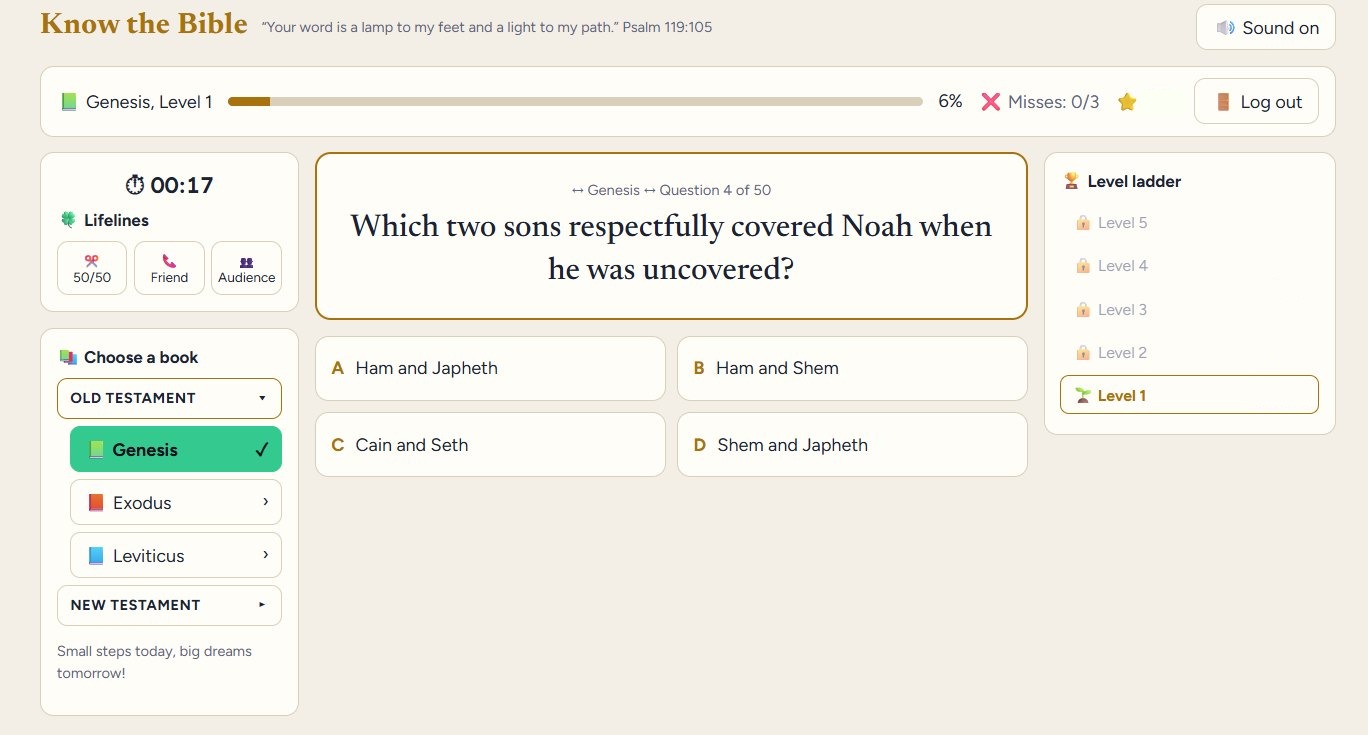
Researchers call this retrieval practice, and it is one of the most reliable ways to learn. Instead of rereading, close the book and try to recall what you have just read. Every time you pull a fact out of memory, the pathway to it becomes stronger. This is exactly why quizzes work so well. A question such as “Which three sons of Noah are named in this chapter?” asks you to retrieve the answer rather than recognise it.
5. Space your practice
Cramming feels productive, but knowledge fades quickly when it is not revisited. Instead, return to a book a few days after you first read it, and again a week or two later. Short, repeated sessions beat one long session. Playing a few questions each day is an easy way to build this rhythm without it feeling like homework.
6. Connect the passages
The Bible is one story told across many books. When you read Luke, notice how it connects with Matthew and Mark. When you study Romans or Galatians, think about how Paul draws on the Old Testament. Seeing these links gives every passage more places to attach in your memory, and it deepens your understanding of the whole.
7. Learn with others
Discussing a passage with a friend, a family member or a study group helps you notice what you missed. Teaching someone else is even better, because explaining an idea reveals whether you truly understand it. Turn a quiz into a friendly family competition, and you will be surprised how much everyone remembers.
Putting it into practice
You do not need to adopt all seven habits at once. Begin with one, perhaps a short daily reading followed by a few quiz questions, and build from there. Consistency matters far more than intensity. Over weeks and months, the details that once slipped away will begin to stay, and your reading will feel richer and more connected.
If you would like a simple way to practise, Know the Bible lets you test yourself on all sixty-six books, one level at a time, in English, Yorùbá, Igbo, Hausa, Pidgin or French. Choose a book you read recently and see how much you remember. Any gaps you find will simply show you where to read next.